The Scharfenberg coupler[1] (German: Scharfenbergkupplung, abbreviated Schaku) is a commonly used type of fully automatic railway coupling.

Designed in 1903 by Karl Scharfenberg in Königsberg, Germany (today Kaliningrad, Russia), the coupler has gradually spread from transit trains to regular passenger service trains, although outside Europe its use is generally restricted to mass transit systems. The Schaku is superior in many ways to the AAR (Janney/knuckle) coupler because it also automates electrical and pneumatic connections and disconnections. However, there is no standard for the placement of these electro-pneumatic connections. Some rail operators have placed them on the sides while others have placed them above the mechanical portion of the coupler. The main disadvantage of the Scharfenberg coupler is the relatively low maximum tonnage it can support, which makes it unsuitable for freight operations.
Working principles
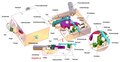
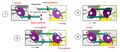
The face of the Scharfenberg coupler has a protruding cone and a matching cup. Inside the cone there is a rigid metal hoop connected to a revolving, spring-loaded metal disk with a notch on the opposite side. When ready to couple, the spring turns the disk so the hoop is extended from the cone. As the cars meet, the hoop enters the cup on the other coupler, stopping against the disk. The hoops are then pressed back into their own coupler, causing the disks to rotate until the notches align with the hoops. After the hoops have entered, the notches on the disks spring back into the hoop extended position, locking the coupling. In the coupled position, forces on the hoops and disk will balance out, which means that the Scharfenberg, unlike many other couplers, is not dependent on heavy latches to stay locked.
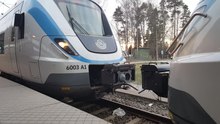
Small air cylinders, acting on the rotating heads of the coupler, ensure the engagement of the components, making it unnecessary to use force to get a good coupling. Joining portions of a passenger train can be done at very low speed (less than 3 km/h or 2 mph in the final approach), so that the passengers are not jolted. One problem with the coupler is that it is often hard to connect it in a curve. Planned coupling is normally done on a straight flat track, while there has been trouble coupling a broken down train at an unplanned place.
- Scharfenberg couplers

Uses
 Play media
Rail equipment manufacturers such as Alstomoffer the Schaku as an option on their mass transit passenger cars and locomotives. Presently, Scharfenberg couplers are in use on the following passenger transit systems:
Australia
- Victoria - V/Line (VLocity 160)
- Victoria - Metro Trains Melbourne(Comeng)
- Victoria - Metro Trains Melbourne (X'Trapolis 100) (also used in Chile)
- New South Wales - Sydney Trains (A & B sets, M set, T set)
- New South Wales - NSW TrainLink (H set, Endeavour railcar, Hunter railcar, Xplorer railcar)
- New South Wales - Sydney Metro (Alstom Metropolis TS set)
- Western Australia - Transperth Trains (A-series train, B-series train)
United States
- San Francisco Bay Area - BART (New Type D and E vehicles)
- San Francisco Bay Area - Muni Metro (New Type 4 vehicles)
- Denver - RTD Bus & Rail (New light rail vehicles)
- Baltimore - Baltimore Light Rail (New light rail vehicles)
- New Jersey - New Jersey Transit (New light rail vehicles)
- Portland, Oregon - TMTC (Light rail vehicles)
- Minneapolis - METRO (Light rail vehicles)
- Norfolk, Virginia - HRT (Light rail vehicles)
Canada
- Montreal - Metro
- Vancouver - Skytrain
- Toronto - Scarborough RT
Europe
- Thalys
- TGV – All French high-speed trains are equipped with Scharfenberg type 10 couplers.
- ICE – All German high-speed trains are equipped with Scharfenberg type 10 couplers.
- Many regional train EMUs and DMUs in Europe
- Rhine-Ruhr Stadtbahn - Almost all German light-rail and streetcar systems use Scharfenberg couplers.
- SBB Cargo – In 2019, the swiss freight operator introducing cargo wagons with Voith CargoFlex, an extension of Scharfenberg type 10 couplers.
- Channel Tunnel - Eurotunnel Le Shuttle
- Narrow-gauge railways in Saxony, Germany
United Kingdom
- Class 175 Alstom "Coradia" units
- Class 180 Alstom "Adelante" units, used on Grand Central and some East Midlands Railway services.
- Class 185 Siemens "Desiro" operated by TransPennine Express.
- Civity UK Class 195 CAF Civity, Class 196 CAF Civity, and Class 197 CAF Civity (proposed).
- Class 332
- Class 333
- All UK Hitachi A-train AT300 including variants such as the 8xx range and the Class 395 including classes such as the Class 395 Javelin AT300, Class 800 IET/Azuma AT300, Class 801 Azuma AT300, and Class 802 IET/Nova 1/Paragon AT300, and the under construction/in testing Class 803 AT300Class 805 AT300, Class 807 AT300, Class 810 Aurora AT300.
Brazil
- São Paulo - Companhia Paulista de Trens Metropolitanos (All vehicles, except 1700and 5400 series)
- São Paulo - Companhia do Metropolitano de São Paulo (Type F, M and P vehicles)
Indonesia
- Soekarno–Hatta Airport Skytrain
Philippines
- Metro Manila MRT Line 3
Singapore
- Mass Rapid Transit
Thailand
- Bangkok - BTS Skytrain (All vehicles)
Additionally, the coupler is in use on some multiple unit trains in Australia.