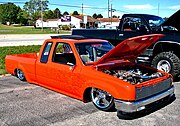
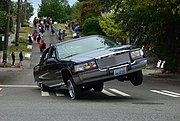
A lowrider or low rider is a customized car with a lowered body.[1] These customized vehicles are generally individually painted with intricate, colorful designs, rolling on wire-spoke wheels with whitewall tires. Lowrider rims are generally smaller than the original wheels, ranging down to 13 inches (330 mm). They are also fitted with hydraulic[2] or air bag systems that allow height adjustable suspension, where the vehicle is raised or lowered at the owner's command.[3] Given these specific characteristics, while a lowrider is always a lowered car, a lowered car is not always a lowrider. The term is used to describe a class of vehicle, not simply the height from ground to chassis.
The term lowrider can also refer to the driver of the car.
Origin and purpose

 Play media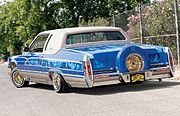
The lowrider car serves no practical purpose. Lowrider car culture began in Los Angeles, California in the mid-to-late 1940s and during the post-war prosperity of the 1950s. Initially, some Mexican-American youths lowered blocks, cut spring coils, z'ed the frames and dropped spindles. The aim of the lowriders is to cruise as slowly as possible, "Low and Slow" being their motto. By redesigning these cars in ways that go against their intended purposes and in painting their cars so that they reflect and hold meanings from Mexican-American culture, lowriders create cultural and political statements that go against the more prevalent Anglo culture.[4] However, this resulted in a backlash: the enactment of Section 24008 of the California Vehicle Codeon January 1, 1958, which made it illegal to operate any car modified so that any part was lower than the bottoms of its wheel rims.
Adding height adjustable suspension
In 1959, a customizer named Ron Aguirre developed a way of bypassing the law with the use of hydraulic Pesco pumps and valves that allowed him to change ride height at the flick of a switch.[5]
Role of Chevrolet Impala
The preceding year, 1958 saw the emergence of the Chevrolet Impala, which featured an X-shaped frame that was perfectly suited for lowering and modification with hydraulics.[6]On this car, the standard perimeter-type frame was abandoned, replaced by a unit with rails laid out in the form of an elongated "X." Chevrolet claimed that the new frame offered increased torsional rigidity and allowed for a lower placement of the passenger compartment. This was a transitional step between traditional perimeter frame construction and the later fully unitized body/chassis, the body structure was strengthened in the rocker panels and firewall. This frame was not as effective in protecting the interior structure in a side impact crash, as a traditional perimeter frame.[7]
Lowrider culture
Between 1960 and 1975, customizers adapted and refined GM X-frames, hydraulics, and airbrushing techniques to create the modern lowrider style.[8]
At first, lowriders were only seen in places like Los Angeles, especially in the 1970s on Whittier Boulevard when lowriding came to its peak. Whittier was a wide commercial street that cut through the barrio of the city in Los Angeles, California. On Saturday nights, young Mexican Americans went cruising along Whittier in their lowriders.
Expanded audience in U.S.
In the 1990s, lowriders became strongly associated with West Coast Hip hop and G-Funk culture. Dr. Dre, Snoop Dogg, Game, Warren G, South Central Cartel, Eazy-E and Above the Law among others featured lowriders prominently in their music videos.[citation needed]
Today, the lowriding scene is diverse with many different participating cultures, vehicle makes, and visual styles. Lowriders today can be seen all over the country, but recently they have been spreading to other places around the world as well.
Expanded audience in Japan
Lowriding culture has also spread to Japan.[9][10][11]
Junichi Shimordaira continues to import and sell these cars through his business, Paradise Road.[12] The spread of lowrider culture and the fame of Paradise Road even raised the attention of Ed Roth, who is famous for creating custom cars such as hot rods and a prominent figure in Kustom Kulture.[13] Since the introduction of lowriders in Japan and the rise of lowriders in Japan in 2001, it is estimated that there are still 200 car clubs that are related to the lowrider scene that are still active to this day.[14]
| This article uses material from the Wikipedia article Metasyntactic variable, which is released under the Creative Commons Attribution-ShareAlike 3.0 Unported License. |